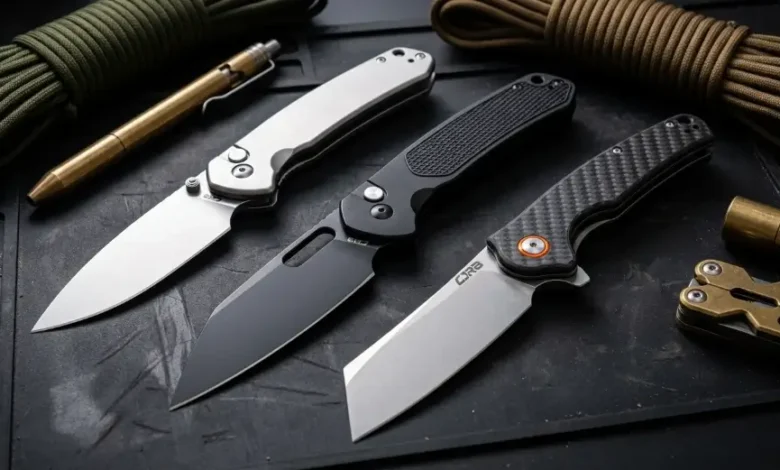
Knives come in many forms, but some designs stand out because of their distinctive mechanisms and handling characteristics. OTF knives and butterfly knives are two examples that have attracted attention among collectors, outdoor enthusiasts, hobbyists, and people interested in tactical-style equipment. Although both are folding or mechanically operated knife designs, they work in very different ways.
Understanding how these knives are designed can help enthusiasts make more informed decisions about collecting, maintenance, storage, and responsible use.
What Are OTF Knives?
OTF stands for “out the front.” Unlike a traditional folding knife, where the blade folds into the side of the handle, an OTF design allows the blade to move along a track and extend from the front of the handle.
The mechanism is one of the main features that makes this style distinctive. Depending on the model, the blade can be deployed and retracted through a built-in sliding or automatic mechanism. OTF Factory describes its product range as including automatic OTF models with different blade materials, handle designs, and finishes.
For collectors, the appeal often comes from the engineering behind the mechanism. The handle must accommodate the blade track, spring system, locking components, and operating controls while remaining compact enough for practical handling.
What Are Butterfly Knives?
Butterfly knives, also known as balisongs, use two handles that rotate around the blade. When closed, the handles cover the blade. When opened, the handles move into position around the blade to form a usable grip.
This design has developed a strong following among knife enthusiasts because of its mechanical construction and distinctive handling characteristics. Collectors may pay attention to factors such as handle materials, pivot construction, balance, finish, and overall build quality.
Unlike an OTF mechanism, a butterfly knife does not move the blade through the front of a fixed chassis. Instead, its two handles rotate around the blade using pivot hardware.
OTF vs. Butterfly Knife: Key Differences
The biggest difference is the operating mechanism.
An OTF knife keeps the blade inside the handle and moves it along a front-facing track. A butterfly knife uses two rotating handles that swing around the blade.
This creates different design priorities:
| Feature | OTF Knife | Butterfly Knife |
| Blade movement | Slides through the front of the handle | Rotates between two handles |
| Main mechanism | Spring and internal track system | Pivot and rotating handle system |
| Design interest | Mechanical deployment | Balance and handle movement |
| Collecting appeal | Mechanism, materials, finishes | Construction, balance, hardware |
| Maintenance focus | Internal mechanism and moving parts | Pivots, screws, and handle hardware |
These differences make each style interesting for different reasons. Someone interested in mechanical knife construction may be drawn to an OTF design, while a collector interested in balance and traditional balisong construction may prefer butterfly knives.
Materials and Construction Matter
The materials used in a knife can influence its weight, durability, appearance, and overall feel. OTF Factory lists options ranging from stainless-steel blades and zinc-alloy handles to aluminum and titanium construction, with premium blade materials such as M390, S35VN, and D2 available for certain projects.
Handle construction is particularly relevant for knives intended for outdoor or collection purposes. Aluminum can provide a relatively lightweight construction, while titanium is often associated with premium builds. Different blade steels also have different characteristics concerning edge retention, toughness, corrosion resistance, and sharpening requirements.
For buyers and collectors, the specific material specification is therefore more useful than simply judging a knife by its appearance.
Why Quality Control Is Important
Mechanically operated knives contain moving components that need to work together accurately. Small manufacturing inconsistencies can affect the feel and reliability of the mechanism.
According to OTF Factory, its quality-control process includes material verification, CNC machining checks, heat-treatment testing, mechanical tuning, and final stress testing. Its stated process also covers pivot systems and handle balance for butterfly knives.
For enthusiasts, these details illustrate why precision manufacturing matters. A knife with a complicated mechanism requires more than an attractive exterior; the internal components, hardware, tolerances, and assembly all contribute to the finished product.
Custom Designs and Knife Collecting
Customization is another area of interest within the knife hobby. Collectors may look for unusual handle finishes, blade shapes, materials, engravings, or limited-production designs. Businesses developing their own knife products may also explore a custom switchblade concept through OEM or ODM manufacturing.
OTF Factory states that it provides OEM and ODM services, including support with 3D designs, custom handles, blade materials, and production.
For hobbyists, however, customization should always be considered alongside local regulations. Laws governing automatic knives, butterfly knives, possession, carrying, transportation, and sale vary considerably between countries, states, provinces, and municipalities.
OTF and Butterfly Knives for Outdoor Hobbies
Knife enthusiasts sometimes include these designs in broader outdoor or camping collections. However, their suitability depends on the particular task, local regulations, and the user’s experience.
For routine outdoor activities, a knife should be selected according to the actual job it is expected to perform rather than simply choosing the most elaborate mechanism. Blade geometry, corrosion resistance, handle comfort, maintenance requirements, and safe storage can all be more relevant than appearance.
Users should also check local rules before transporting or carrying mechanically operated knives outdoors. A knife that is legal to own may have different restrictions concerning public carry or transportation.
Responsible Handling and Maintenance
Regardless of design, safe handling should be a priority. Knives should be treated as cutting tools rather than toys, and users should avoid experimenting with mechanisms in crowded or unsuitable environments.
Regular maintenance can also help preserve a knife’s condition. Moving components should be kept clean according to the manufacturer’s instructions, while screws, pivots, springs, and locking components should be checked periodically. A damaged or malfunctioning mechanism should not be used until it has been properly inspected or repaired.
For collectors, secure storage is equally important. Keeping knives in a dry location and away from unauthorized users can help protect both the collection and the people around it.
Choosing Between the Two Styles
There is no single design that suits every knife enthusiast. OTF knives emphasize a compact front-deployment mechanism, while butterfly knives are built around rotating handles and pivot hardware.
Collectors interested in engineering may want to study the internal construction of OTF models. Those interested in balisong design may instead focus on handle materials, pivot systems, balance, and craftsmanship.
Whichever style attracts your attention, researching construction quality, intended use, maintenance, and applicable knife laws can make the hobby more informed and responsible.